Location scouting is one of those parts of production that looks easy from the outside. You find a place that looks good. You shoot there. Done.
The reality is closer to detective work. A location can look perfect in photos and be unusable on the day. Or it can look ordinary and turn out to be the best decision you made on the entire shoot. Knowing the difference is mostly about what you check before you commit.
Light Is the First Question, Not the Last
Most clients pick locations based on how a place looks in their head. Most directors pick them based on how they'll photograph at the time of day you're actually shooting. Those are two different things.
A south-facing window that looks beautiful in mid-morning photos will be blown out at noon. A space with gorgeous wood floors might have overhead fluorescents that no amount of color correction will fully fix. Tungsten and daylight mixed in the same frame is a problem you don't want to discover at 9am on shoot day.
Visit the location at the actual time you plan to shoot. If the call time is 7am, scout it at 7am, not at 2pm on a different day of the week. The light will move differently than you expect, and you need to see it.
Sound Is the Thing That Kills You
Visuals can be salvaged. Audio almost never can. Bad audio is the single most common reason small-budget shoots end up looking amateur, and almost all of it traces back to the location.
Walk the space and listen. HVAC systems that cycle on every fifteen minutes. Refrigerator compressors. Fluorescent ballast hum. Traffic noise from the street. Construction two blocks away. A neighbor who runs a leaf blower at 10am. The school across the street that lets out at 3pm. None of this shows up in a photo.
Outdoor locations come with their own problems. Beaches are a good example. They look cinematic and clients love them. They also have wind, and wind is brutal on audio. A steady ten-mile-an-hour breeze will render most dialogue unusable without serious wind protection, and gusts are worse. Add wave noise, which never stops and sits in exactly the low-to-mid frequency range that human voices live in. Seagulls overhead. The occasional jet ski. A group of kids fifty yards away. You can get clean audio on a beach, but it requires a proper boom operator, serious wind protection (fuzzy dead cat, not just the foam), and sometimes lavs plus boom plus a backup of both. Budget for it before you commit to the location.
If you can hear it standing in the room, the boom mic will hear it ten times worse. The fix is either to find a different location, plan around it (shoot during quiet windows), or accept that you'll need to ADR dialogue later, which costs money and rarely sounds as good as production audio.
Power, Parking, Permits
The unglamorous list. It's also the list that determines whether your shoot day is smooth or chaotic.
Power: count the outlets and figure out the breaker capacity. A small lighting package can pull more than a residential circuit can handle. Pop a breaker mid-take and you've lost the moment. If you're running a generator, where does it go and how loud is it.
Parking: where does the crew park, where does the truck park, how far is the carry from the truck to the set. A 200-foot carry up a flight of stairs adds an hour to load-in and an hour to wrap, and your crew will hate you.
Permits: most jurisdictions require a permit for commercial filming, even on private property in some cases. New York City has its own film office and process. Other municipalities have their own rules. "We'll just shoot guerrilla style" is a fine plan until a cop shuts you down two hours into a four-hour shoot.
The Owner Conversation
The person who owns or manages the location is your most important relationship on a location shoot. Not the talent. Not the client. The owner.
Be honest about what you're going to do. How many people will be there. What time you'll arrive and leave. Whether you'll move furniture. Whether you'll need to remove things from walls. Whether you'll be using lights, smoke effects, anything that triggers alarms. Get all of this in writing. Pay for the location even if they offer it free, because a paid relationship is a clearer relationship.
This gets harder, not easier, when the location belongs to a family member or friend of the client. The instinct is to treat it as a favor and skip the formal conversation. Don't. The problems on those shoots are usually the ones nobody planned for. We had a shoot in a family member's home where we were asked to remove our shoes at the door. Reasonable request for a home. Nobody told us in advance, and we didn't bring booties. The crew and actors spent the day in socks on hardwood floors, which is a real safety issue when you're carrying stands and cases and running cable. Several shots had to be reset because feet kept ending up in frame. A ten-minute conversation the day before, and a pack of booties in the grip truck, would have solved all of it. The lesson is that you should ask the same questions you'd ask a rental location, and you should ask them before the day.
And leave the place better than you found it. Word travels in this industry. The locations that get used over and over are the ones where the production company didn't trash the place and didn't disrespect the owner.
The Backup Plan and Weather
Always have one. Always.
An exterior shoot has weather as the obvious risk. But interior shoots get derailed too. Buildings get sold. Owners change their mind the day before. Pipes burst. The plumber shows up and starts banging on the wall in the next room while you're rolling. Lock in a second option you can move to with twenty-four hours notice. You probably won't need it. The day you do, it will save the entire shoot.
Weather contingencies deserve their own plan, not just a backup location. For any outdoor shoot, you need pop-up tents or easy-ups for talent and crew, enough umbrellas for the entire team, towels for gear and for people, plastic rain covers for cameras and sound equipment, and hand warmers if there's any chance of cold. You need more of all of this than you think. We had a multi-day shoot in Coney Island where the last day turned cold and brought steady rain. We had some covers and a few umbrellas and not nearly enough towels, and it showed. Crew got cold, gear got wetter than it should have, and people pushed through when they shouldn't have. The shoot got finished, but the day was harder than it needed to be and some of the performances were affected by how miserable everyone was.
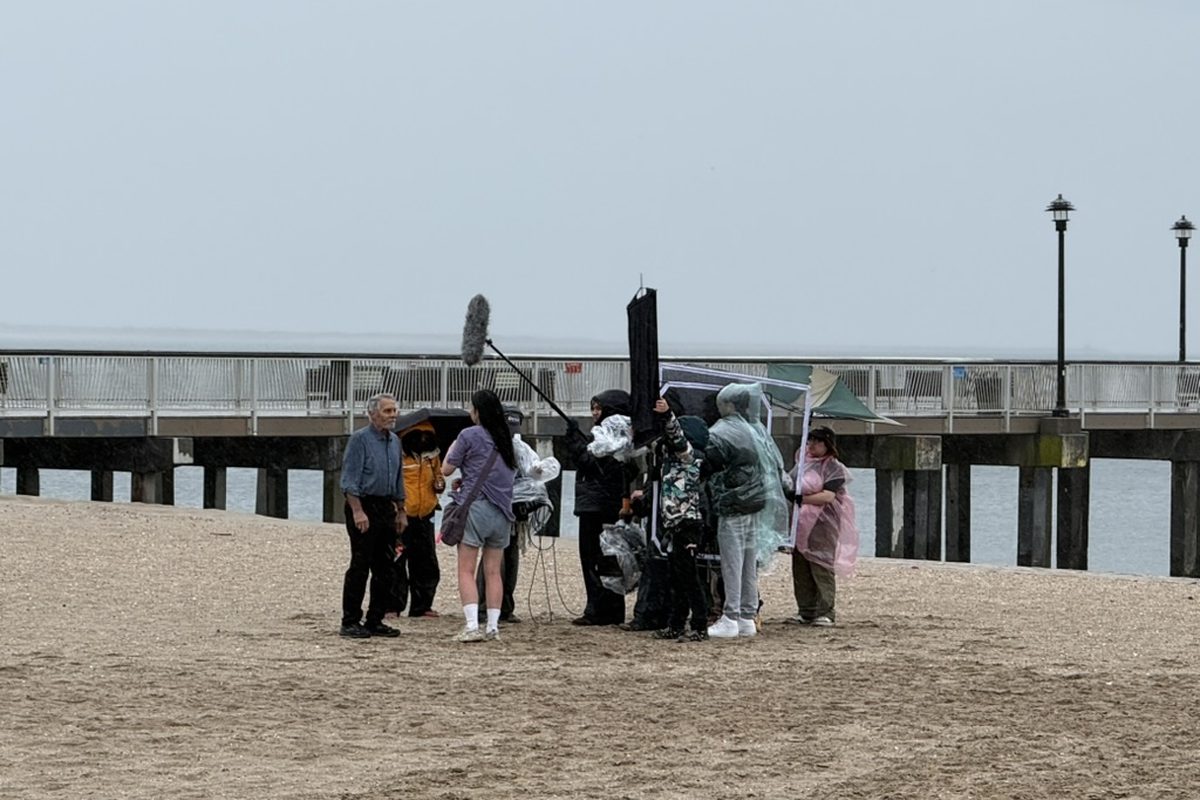
Shoot day at Coney Island. Ponchos on, boom up, everyone making it work. We got the shots. We also learned that "some umbrellas" and "a few towels" is not a weather plan.
The rule we use now: budget for full weather coverage on every outdoor shoot even if the forecast is perfect. A box of cheap umbrellas, a pack of microfiber towels, two easy-ups, and a roll of rain covers is a few hundred dollars of insurance. If the weather holds, you haven't lost much. If it doesn't, you've saved the day.
The Honest Truth About Pretty
Beautiful locations are a trap. The instinct is to find the most visually impressive space you can afford and shoot there. Sometimes that's right. More often, the right location is the one that supports the story without distracting from it.
A plain room with controlled light, quiet sound, and easy access will produce better footage than a beautiful loft with bad acoustics, no parking, and a landlord who shows up at 1pm asking when you'll be done. The pretty location is exciting in pre-production. The functional location is a relief on shoot day.
Pick the location that lets you do good work, not the one that looks best on Instagram. The audience won't remember the room. They'll remember whether the piece worked.